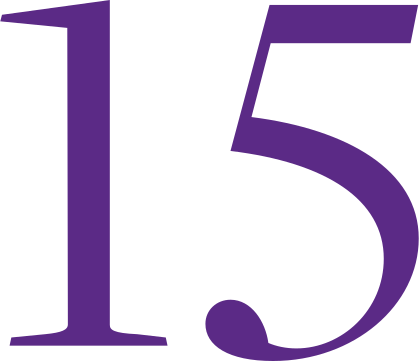
Fifteen pillars.
One system.
Change one,
the rest follow.
Ignore them,
nothing changes.
01 — Fair Pay
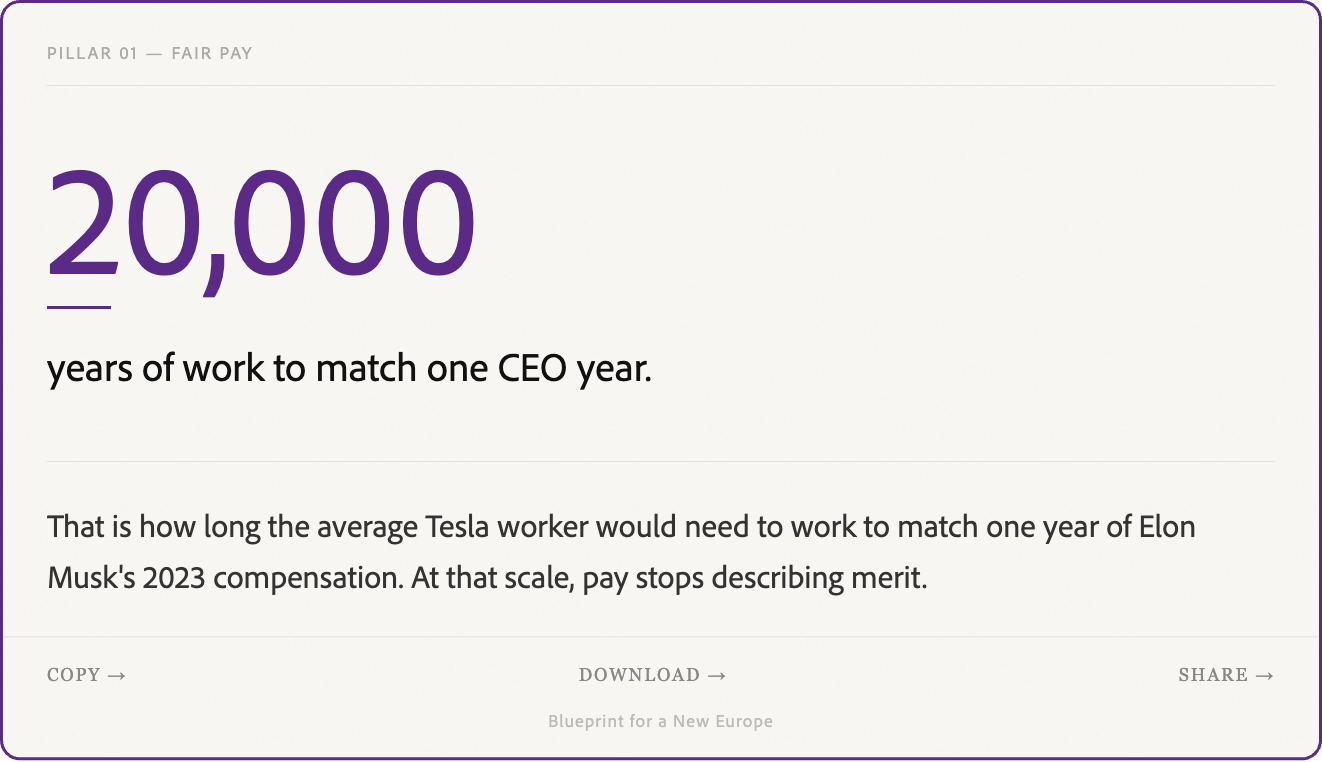
The forty-year rule. 20,000 years of work to earn what one executive earns in one.
Forty years, The cap does not ban wealth. It restores proportion. Fair pay begins the repair.
02 — Tax fairness
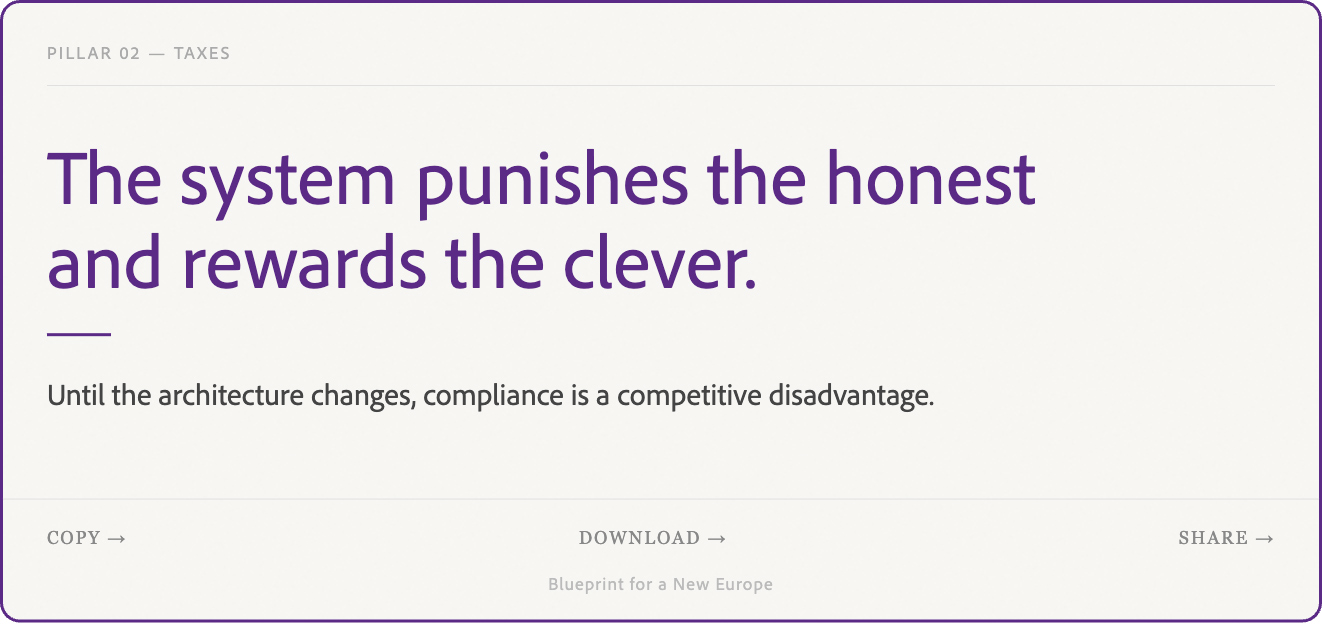
The price of civilization. A healthy economy moves. The wealthiest do not.
They borrow against assets that grow tax-free. They hoard. They die before the bill comes due.
Sofia cannot do this. Neither can her bakery. Neither, probably, can you.
03 — Fair trade
Open but not naïve. Spotify pays Apple thirty percent of every European subscription, for the privilege of running on a phone Europeans bought. That is not a market. That is tribute.
Europe is the largest single market in the world. We negotiate as if it were the smallest.
04 — Education
Preparing free, resilient, creative citizens. Estonia spends less than Germany and outperforms it by a generation. The gap is not talent. It is architecture.
The question is not how to fund the system we have. It is which system to build.
05 — Universal healthcare
The continent that can heal itself. Anna did everything right. The system failed her anyway. Healthcare is not a reward for citizenship in the right country, it is the precondition for citizenship itself. Not charity. Civilisation.
06 — Housing
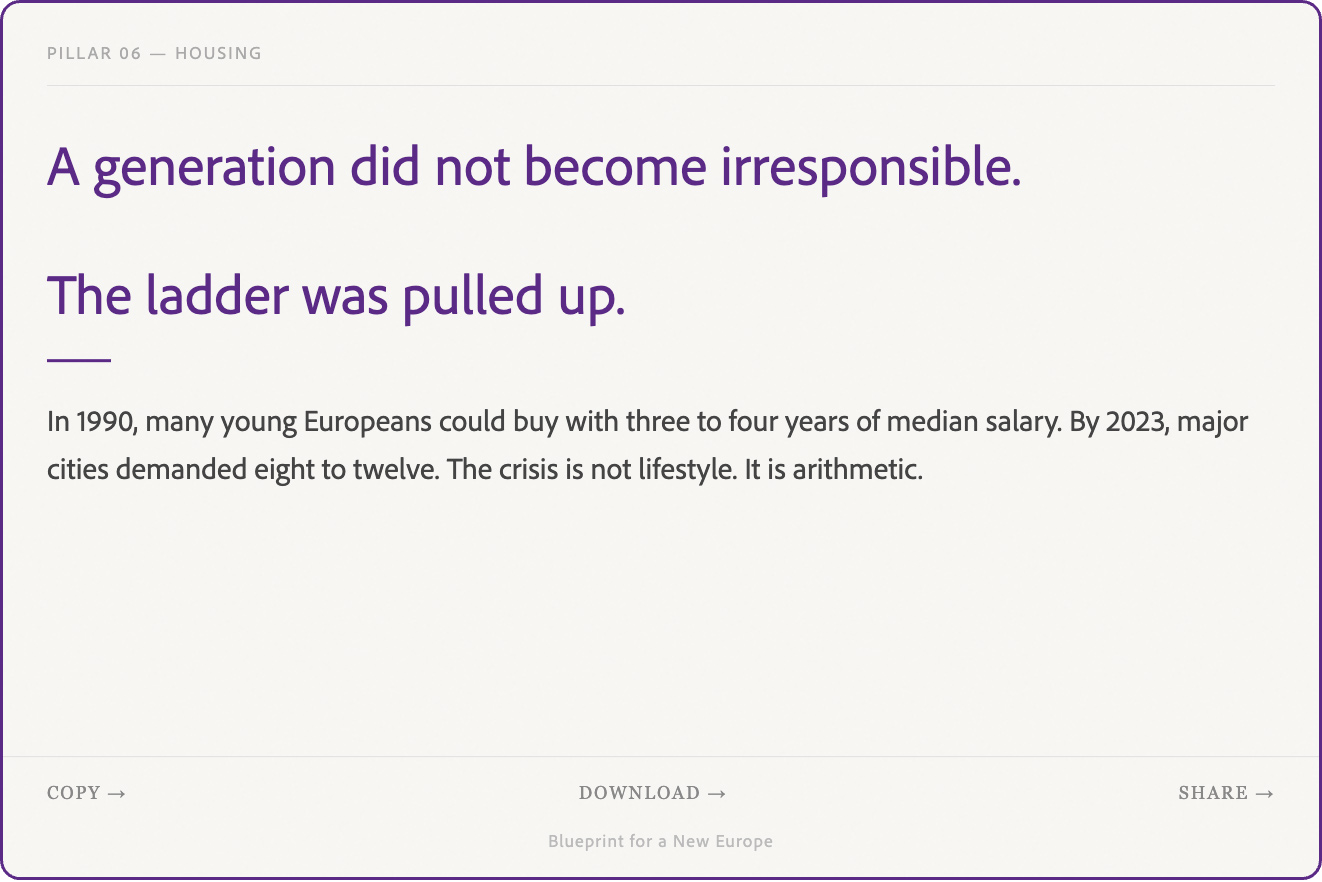
The foundation of dignity. Your grandfather built a house on a starting salary. You will need an inheritance to buy a flat. Stability is not the prerequisite for a home, it is the consequence of one. Capital that builds is welcome. Capital that bleeds is not.
07 — Smart drug policy
The war that never ended. Regulation doesn’t celebrate use. It disciplines chaos. Prohibition didn't end drugs, it decided who gets punished for them. Society’s job is not to make sure nobody ever falls. It’s to make sure that if you do, the fall doesn’t have to be fatal.
08 — Climate & environment
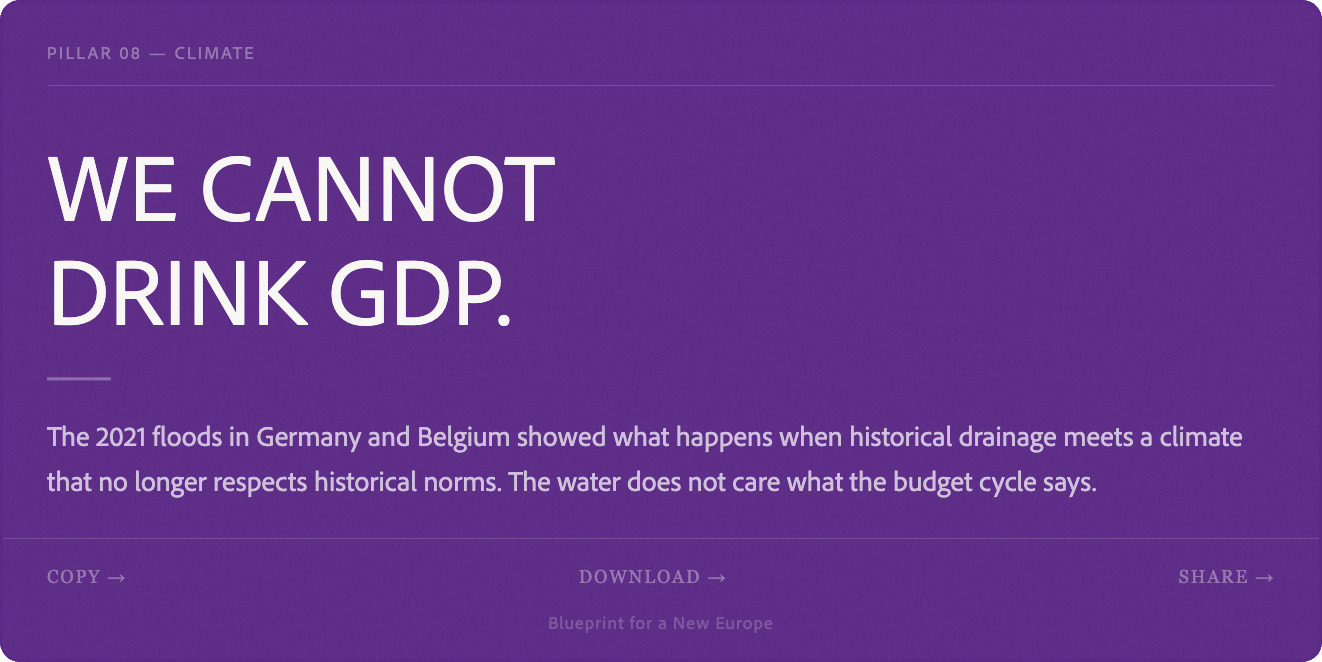
The final foundation. A continent that can defend its borders but not its rivers has misunderstood what security means. Every other reform requires a continent still capable of sustaining them.
We cannot drink GDP.
09 — Defence, security & sovereignty
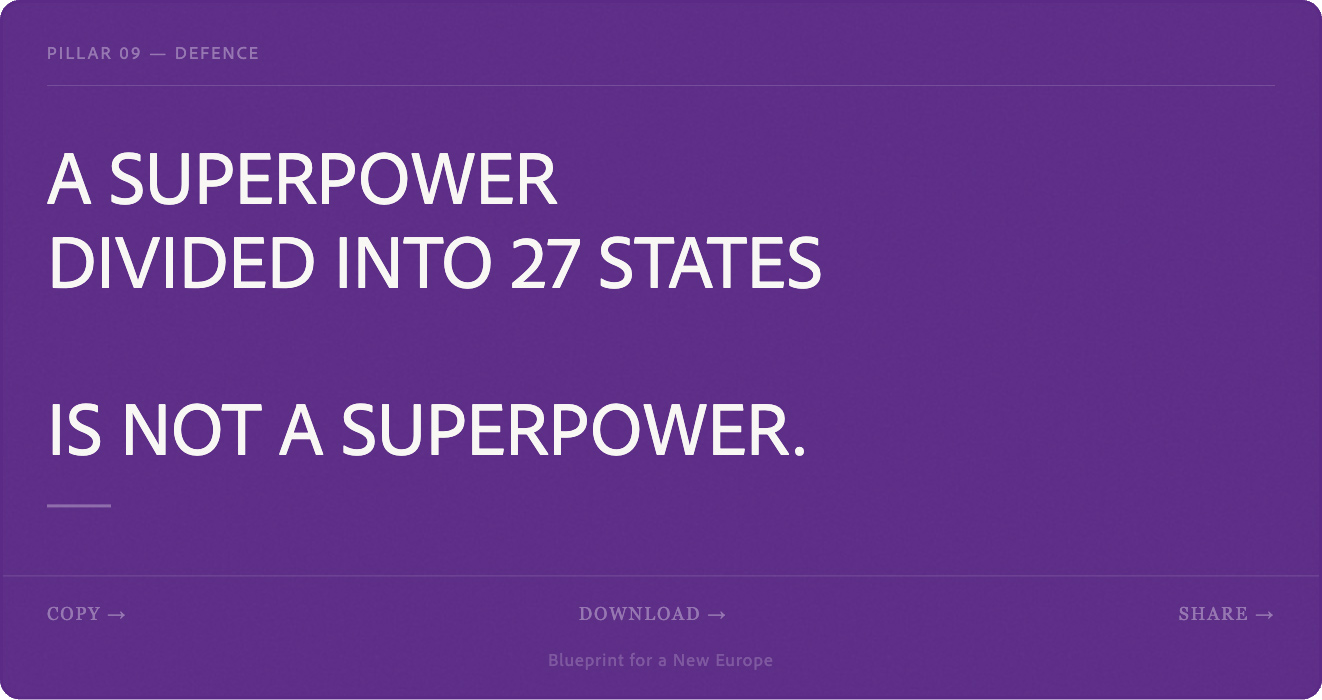
Europe's shield and compass. A superpower divided into 27 states is not a superpower. Europe runs 178 weapons systems where the United States runs 30. Apart, we are picked off one by one.
Together, we are a lion.
10 — Justice
The foundation beneath all foundations. National prosecutors convict corruption at 30%. The European Public Prosecutor's Office convicts at 95%, understaffed, underfunded, locked out of five member states. The machine that catches the powerful already exists. We just refuse to let it run.
11 — Media & information
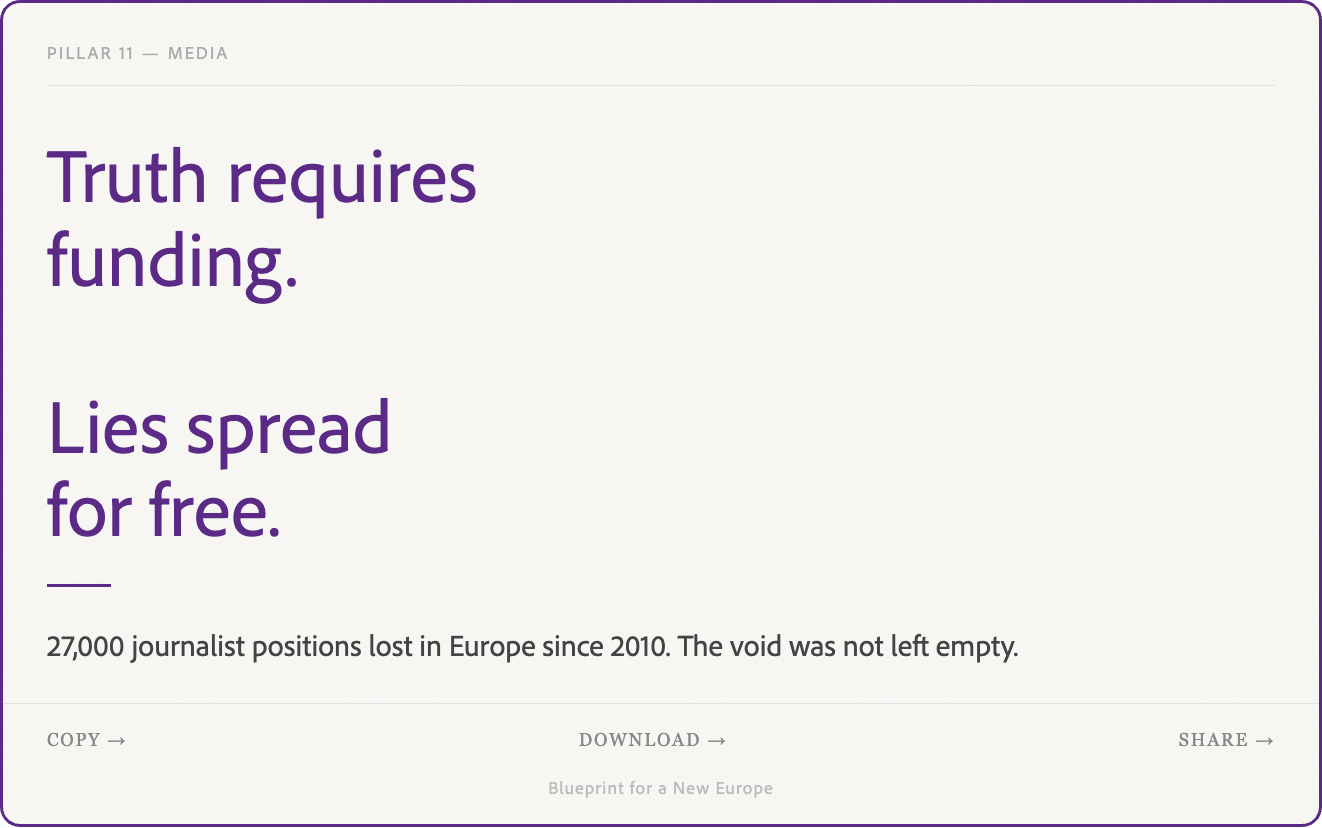
Democracy's immune system. Behind every front page sits an owner. Behind every algorithm, a decision. Both are invisible. The cost is not that citizens believe lies. It is that they stop believing anything at all. Transparency is not control. It is oxygen.
12 — Transparency & anti-corruption
Every euro traceable. When nobody checks, money disappears. When everything is visible, corruption collapses. This is not about ethics. It is about architecture that makes theft impossible and honesty the only viable option. Taxes are meant to serve the people. Systems decide if they do.
13 — Institutional democratisation
The living spine of democracy. 6 in 10 Europeans cannot name a single EU project in their region. The institutions know this. They call it a communication problem. Citizens who lose faith in institutions do not become reformers. They become prey for anyone promising to burn the system down.
14 — Technology & innovation
The brain drain. Europe trains. Others hire. Europe regulates. Others build. We chose protection over propulsion and called it stability. This is not destiny. It was a decision. It can be reversed.
However, the window is measured in years, not decades.
15 — Cultural identity
The hive we forgot we built. We are not becoming European. We already are. The connections exist in stories, habits, shared references. The question is not identity. You can belong to a village and a continent simultaneously. The roots don’t shrink when the branches grow.
We forgot that we built this together. It is time to remember.
Click to explore the pillar